Practical DJ-tested strategies for building a wedding reception dance floor that stays full from the first song to the last in Baltimore, DC, and the DMV.
Why the Dance Floor Is the Heartbeat of Your Wedding Reception
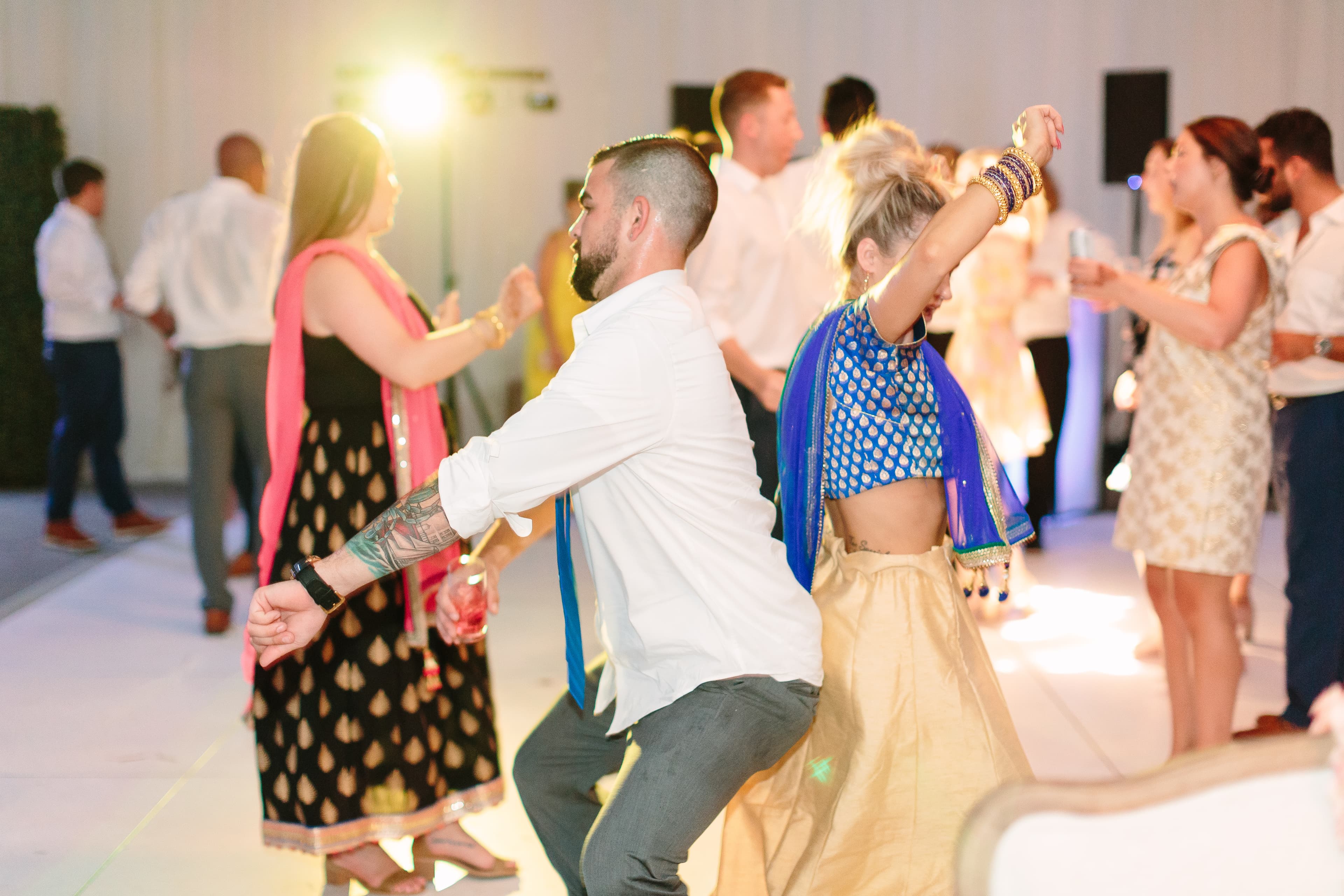
Every couple I meet during the planning process tells me the same thing: they want their guests dancing all night. Nobody dreams of a wedding where half the room is sitting at their tables scrolling through their phones while three brave souls shuffle awkwardly on an empty dance floor. The dance floor is where your wedding transforms from a nice dinner with speeches into a full-blown celebration, and a packed dance floor is the single clearest sign that your reception is a success. After providing entertainment for hundreds of weddings across Baltimore, DC, and the DMV, I can tell you with confidence that the difference between a legendary wedding and an average one almost always comes down to what happens on that dance floor.
The challenge is that a packed dance floor does not happen by accident. It is the result of deliberate decisions made weeks and months before the wedding day, combined with real-time adjustments by an experienced DJ who knows how to read a crowd. Everything from your reception timeline to your venue layout to your song selections to your lighting design plays a role in whether your guests spend the evening on their feet or planted in their chairs. The good news is that every single one of these factors is within your control, and when you understand how they work together, building a dance floor that stays full all night becomes a repeatable formula rather than a lucky accident.
What makes the DMV wedding scene unique is the diversity of the crowds. A typical Baltimore or DC wedding might include guests ranging from college friends in their twenties to grandparents in their eighties, colleagues from a government agency, neighbors from the suburbs, and family who flew in from across the country. That age range and cultural mix means the DJ cannot rely on a single genre or era to keep everyone moving. The playlist has to be a living, breathing thing that evolves through the night, pulling in songs that connect with every generation and every pocket of the guest list without ever losing momentum. When you get that balance right, the magic that happens on the dance floor is unlike anything else in the wedding.
Baltimore and DC also offer an incredible variety of reception venues, from waterfront spaces in Harbor East to historic ballrooms in Georgetown to barn properties in Maryland horse country, and each of these settings creates a different dance floor dynamic. A wide-open ballroom with a dedicated hardwood floor invites guests to spread out and dance from the moment the music starts. A more intimate space in Fells Point or Adams Morgan creates a close-quarters energy that can feel electric when the room is full but awkward if people are hanging back. Understanding how your specific venue shapes the dance floor experience is one of the first things I assess when I take on a new wedding, and it directly informs every decision from speaker placement to playlist strategy.
Building a Reception Timeline That Maximizes Dance Floor Time
The single biggest dance floor killer at weddings across Baltimore and DC is a reception timeline that leaves too little time for open dancing. I see this constantly: the couple books a five-hour reception, but by the time you subtract cocktail hour, dinner service, speeches and toasts, the first dance, parent dances, cake cutting, the bouquet toss, and a sparkler exit, there is barely ninety minutes left for actual open dancing. That is not enough time to build the kind of momentum that keeps a dance floor packed. You need a minimum of two hours of uninterrupted open dancing to create the arc of energy that takes a room from casually moving to full-on celebration, and three hours is even better if your venue and timeline allow it.
The most effective timeline strategy I recommend to my DMV couples is front-loading the formalities. Move your toasts and speeches to the dinner hour rather than saving them for after dinner. Have the best man and maid of honor speak between courses while guests are seated and eating. Do the cake cutting during dinner service rather than treating it as a standalone event later in the evening. When you consolidate these formal moments into the meal portion of the reception, you create a clean break between dinner and dancing where the DJ can open the floor and keep it open without interruptions. Every time the music stops for another speech or another formal moment during the dancing portion of the night, you lose people from the floor who may not come back.
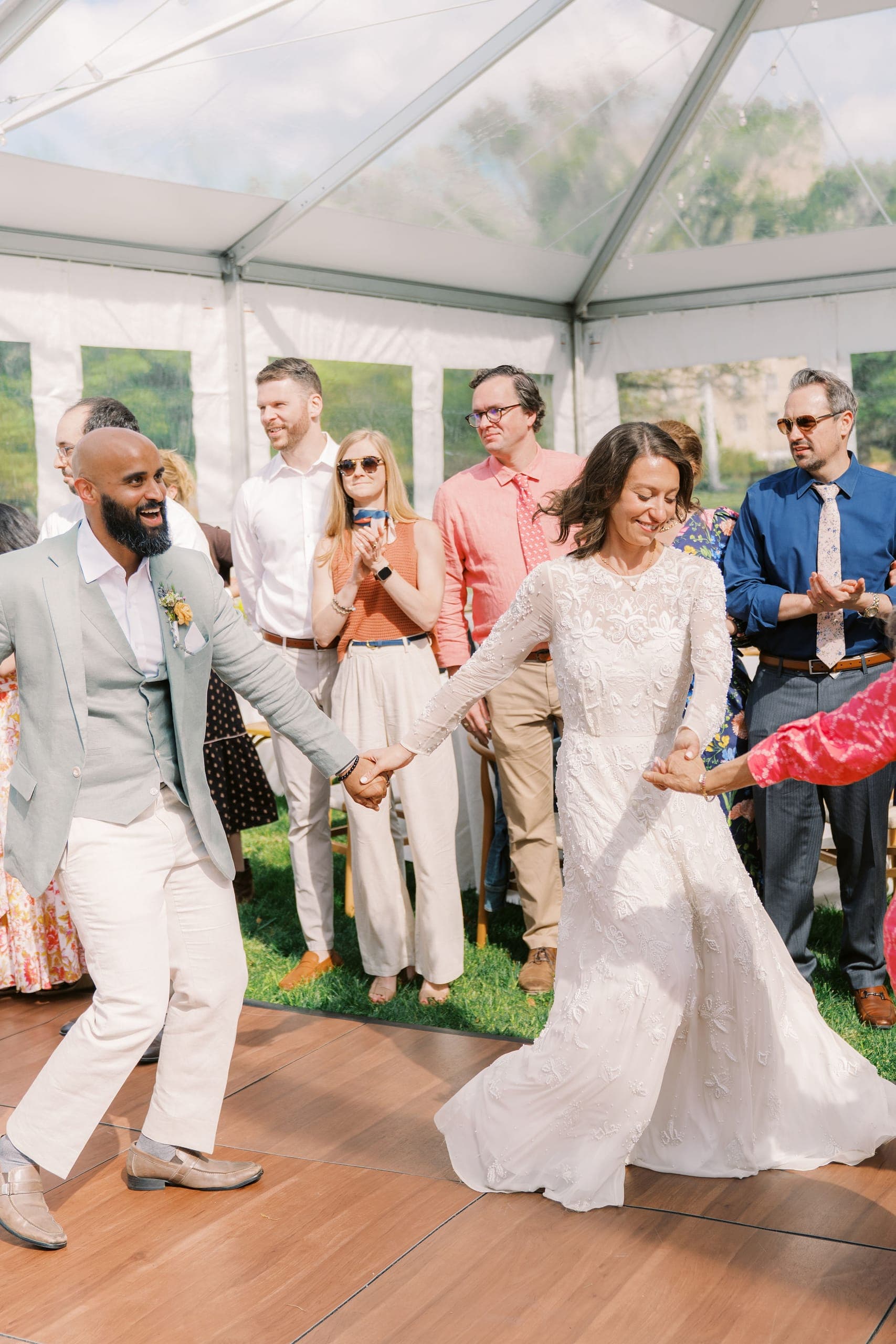
The first dance and parent dances are beautiful traditions, but their placement in the timeline has a major impact on dance floor energy. I recommend doing the first dance immediately after the couple is introduced, followed directly by the parent dances, and then transitioning straight into open dancing. This approach uses the emotional energy of those intimate dances as a launchpad into the party rather than interrupting the party later to go back to slow, formal moments. When the father-daughter dance ends and the DJ seamlessly transitions into an uptempo song that pulls the whole room onto the floor, the momentum carries forward naturally. If instead you wait until an hour into open dancing to pull everyone off the floor for a parent dance, you break the spell and have to rebuild the energy from scratch.
For weddings at DMV venues with curfews or noise restrictions, timeline planning becomes even more critical. Many popular venues in Fells Point, Capitol Hill, Georgetown, and Old Town Alexandria have hard stop times of ten or eleven at night. If your reception starts at seven and music must end at ten-thirty, you have a tight window. I work with couples at these venues to create timelines where open dancing begins no later than eight-fifteen, giving us a solid two hours of dance floor time before the final song. That might mean a shorter cocktail hour, a more efficient dinner service, or speeches delivered during the cocktail hour rather than during the reception. The earlier the formalities wrap up, the more dance floor time your guests get to enjoy.
Crafting a Playlist That Connects with Every Guest in the Room
A packed dance floor starts with a playlist that is built for your specific crowd, not pulled from a generic wedding template. Every guest list has its own personality shaped by age demographics, cultural backgrounds, regional tastes, and the couple's own musical identity. Before every wedding I work in Baltimore, DC, or anywhere in the DMV, I spend time learning about who will actually be in the room. Are most of the guests from the same generation, or is there a wide age spread? Are there cultural communities represented that have specific musical traditions? Does the couple lean toward a particular genre or era, and are their guests likely to share that taste? These questions shape a playlist that feels personal and intentional rather than generic, and that specificity is what keeps people on the floor.
The opening songs when the dance floor first opens are the most important playlist decisions of the entire night, and getting them right sets the tone for everything that follows. You need songs that are universally recognized, emotionally uplifting, and impossible to resist. This is not the time for deep cuts or niche favorites. I typically open with three to four songs that cross generational lines: think Motown classics that grandparents know by heart, eighties anthems that the parents' generation loves, or early two-thousands hits that the couple's friends grew up on. The goal is to get as many people on the floor as possible in the first ten minutes, because once the floor is full, social momentum takes over. People stay on a crowded dance floor because everyone around them is dancing. They leave an empty one because nobody wants to be the only person out there.
As the night progresses, the playlist should follow an energy curve that builds gradually, peaks in the final hour, and ends on a high note that leaves guests wanting more. I think of it as three acts. The first act, right after dinner, is warm-up territory: classic feel-good songs, sing-alongs, and crowd-pleasers that invite participation without demanding high energy. The second act raises the tempo and introduces more contemporary hits, mashups, and genre-blending transitions that challenge the crowd to match the escalating energy. The third act is the peak: this is where the biggest bangers live, the songs that make people scream when they hear the opening notes, the tracks that fill every square inch of the dance floor. Ending the night at the peak rather than winding down ensures your guests leave buzzing rather than watching the crowd thin out.
Song requests from guests can be a blessing or a curse depending on how your DJ handles them. I always accept requests at weddings because they give me real-time data about what the crowd wants to hear, and honoring a request makes that guest feel seen and keeps them on the floor. But not every request fits the current moment. If the dance floor is at peak energy and someone requests a slow ballad, playing it right then would kill the momentum. A skilled DJ files that request mentally and finds the right moment for it later, perhaps during a brief cool-down before building back up. I also encourage couples to create a short do-not-play list of songs they absolutely do not want to hear, which prevents any awkward surprises without requiring the couple to micromanage every song choice.
Reading the Room: What a Great DJ Does That a Playlist Cannot
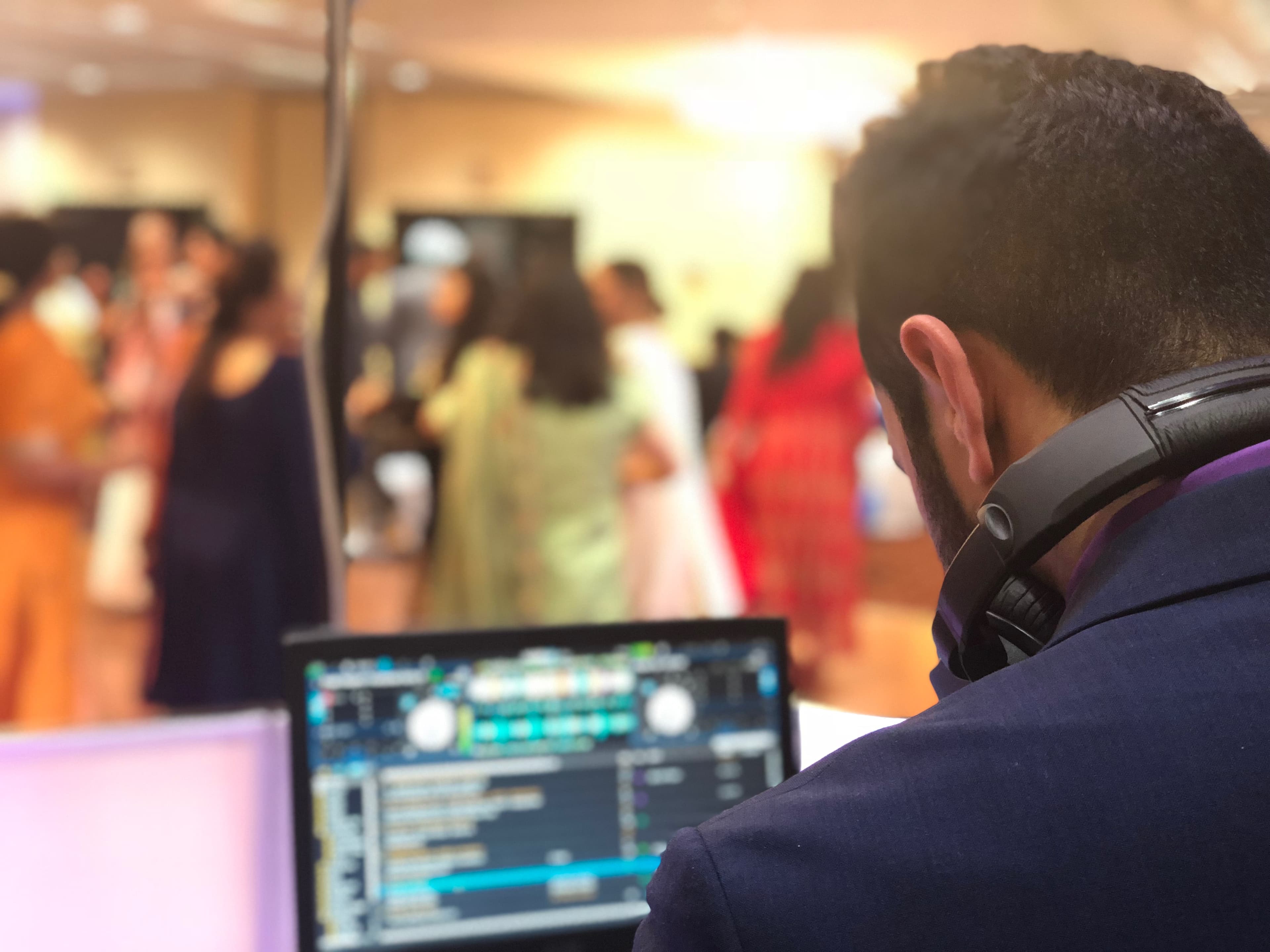
The most important skill a wedding DJ brings to the table is something no Spotify playlist or AI algorithm can replicate: the ability to read a room full of real human beings in real time and adjust the music accordingly. A playlist is static. It does not know that the older guests are starting to sit down because the last three songs skewed too young. It does not notice that the dance floor exploded during the throwback hip-hop segment and will empty out if the next song is a country track. It cannot sense that the energy is dipping and this exact moment needs a song that everyone in the room knows the words to. A great DJ is processing all of this information constantly, making micro-adjustments to the song selection, the tempo, the transitions, and the volume to keep the floor packed.
One of the techniques I use at nearly every wedding in the DMV is what I call anchor songs. These are songs that I know will bring a specific group of guests to the floor every single time, and I space them strategically throughout the night to prevent any one demographic from feeling neglected. If I notice the older crowd starting to drift back to their seats, I will drop a Motown or classic rock anchor that pulls them back. If the younger guests are dominating the floor and the middle-aged group is watching from the sidelines, a well-timed nineties hip-hop or R&B anchor brings them right back. The goal is to keep rotating through the musical touchpoints that matter to each segment of the crowd so nobody feels like the party has moved past them.
Transitions between songs are another area where a professional DJ creates value that is impossible to replicate with a pre-made playlist. A hard cut between two songs with different tempos or energies creates a jarring moment where people stop dancing and assess whether they like the next song enough to stay. A skilled DJ blends songs together so the transition feels seamless, matching beats, using harmonic mixing to keep the key signatures compatible, and layering elements so the new song builds in before the old one fades out. These smooth transitions maintain the physical momentum of dancing, because your guests never have a reason to stop moving. The best compliment I receive from wedding guests is when they tell me the music felt like one continuous experience rather than a collection of individual songs.
Volume management is a subtle but critical part of keeping a dance floor alive throughout a long reception. The right volume for dinner background music is completely wrong for peak dance floor energy, and the right level for a packed floor at ten at night is too loud for the first open dance song at seven-thirty. I manage volume as a living element of the reception, gradually increasing it as the energy builds and the crowd grows, and pulling it back slightly during transitions or cool-down moments to give guests' ears a rest before pushing the energy back up. Many DMV venues also have sound level requirements that the DJ must respect, and an experienced DJ knows how to deliver high-energy dance music within those limits by using speaker positioning and equalization rather than just raw volume.
Lighting, Effects, and Production That Elevate the Dance Floor Experience
The visual environment of your dance floor has a bigger impact on whether guests dance than most couples realize. Think about the last time you walked into a venue where the dance floor was brightly lit under harsh fluorescent lights with nothing to distinguish it from the rest of the room. You probably did not feel an urge to get out there and dance. Now think about walking into a space where the dance floor is bathed in warm, colorful lighting, the rest of the room is dim and ambient, and the visual energy of the space pulls your eyes toward the center of the action. That second scenario is not magic. It is intentional lighting design, and it is one of the most powerful tools a DJ has for keeping the floor packed all night.
Uplighting is one of the simplest and most effective ways to transform the atmosphere of a DMV wedding venue. Wireless LED uplights placed around the perimeter of the room wash the walls in color, creating a warm, immersive environment that makes the entire space feel like a celebration. For the dinner portion of the evening, I typically set uplighting to soft, warm tones like amber or blush that complement the decor and create an elegant atmosphere. When the dance floor opens, the lights shift to more vibrant, dynamic colors that signal to guests that the energy is changing and it is time to move. That visual cue is surprisingly effective at drawing people out of their seats and onto the floor. Venues across Baltimore, DC, Bethesda, and Northern Virginia all benefit from uplighting because it works equally well in a rustic barn, a modern loft, or a classic ballroom.
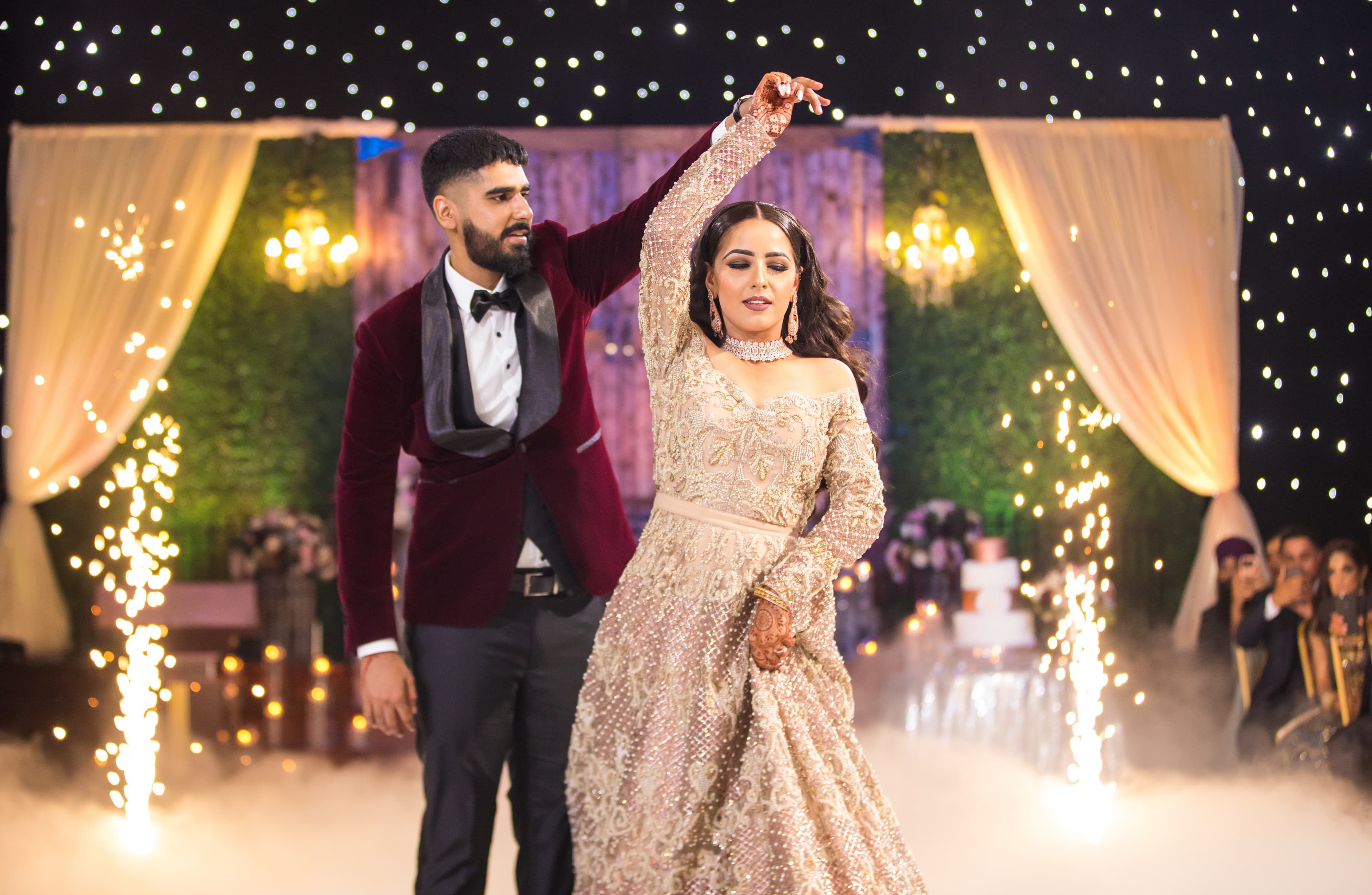
Intelligent moving lights, cold sparks, CO2 effects, and haze machines take the dance floor experience to another level for couples who want a more dramatic production. Moving head lights create sweeping beams and patterns that give the dance floor a concert-like energy during peak moments. Cold sparks produce a spectacular fountain of sparks without heat or fire risk, making them safe for indoor venues and stunning for key moments like the first dance or a late-night peak. CO2 cannons create bursts of fog that explode over the crowd and add a festival atmosphere. These effects should be used strategically at peak moments rather than running continuously, because their impact comes from contrast. A burst of cold sparks during the biggest song of the night hits completely differently than cold sparks running all evening.
The physical layout of the dance floor relative to the DJ booth, the bar, and the guest seating also influences how naturally guests move between sitting and dancing. Ideally, the dance floor should be centrally located and visible from every table, so guests can see the energy building and feel drawn in. Positioning the bar adjacent to the dance floor rather than across the room means guests can grab a drink and step right back onto the floor without losing their momentum. At many DMV venues, I work with the couple and their planner during the floor plan stage to optimize the layout for maximum dance floor accessibility, because even small changes in table placement and DJ positioning can make a noticeable difference in how freely guests flow between the bar, their seats, and the dance floor.
Common Dance Floor Killers and How to Avoid Them
After hundreds of weddings in the DMV, I have identified the most common dance floor killers that deflate even the most enthusiastic crowd, and every single one of them is preventable. The number one killer is the late start. When the dance floor does not open until nine-thirty or later because dinner ran long and speeches went overtime, you have already lost your window. Older guests are tired, some people have left, and the remaining guests have been sitting for so long that the activation energy required to get them moving is much higher. Protecting your dance floor start time should be a priority in every planning conversation, and every vendor from the caterer to the photographer to the officiant needs to understand that running behind schedule directly impacts the party.
The second most common killer is a gap in the music during the dancing portion of the evening. This happens when additional formal events are squeezed into the dance floor segment: a late anniversary dance, a bouquet and garter toss that requires a full production pause, a surprise slideshow that nobody really wants to watch standing up on a crowded dance floor, or a second round of toasts from extended family members. Every time the music stops and the lights come up, guests scatter to the bathroom, the bar, their phones, or the exit. Getting them all back is exponentially harder than keeping them there in the first place. If there are additional formal moments you want to include, schedule them before open dancing begins or build them into the natural cool-down moments of the music rather than stopping the party cold.
Temperature and comfort are silent dance floor killers that couples rarely think about until the day of the wedding. A reception venue that is too warm will drive guests off the dance floor no matter how great the music is, because nobody wants to dance in a room that feels like a sauna. Conversely, a venue that is aggressively air-conditioned can make the dance floor feel unwelcoming when guests' sweat meets cold air. If your reception is outdoors at a Maryland or Virginia summer venue, heat and humidity are real threats to dance floor longevity, and renting fans, misting stations, or a climate-controlled tent is not a luxury but a necessity. I always recommend doing a temperature check with your venue coordinator and having a plan for adjusting the thermostat once the dance floor fills up and body heat starts raising the room temperature.
Finally, an uncomfortable or poorly sized dance floor will undermine even the best music and lighting. A dance floor that is too small for your guest count creates a sardine effect where people bump into each other and eventually give up. A dance floor that is too large makes a healthy crowd of dancers look sparse and discourages others from joining because the space looks empty. The general rule of thumb is to plan for about nine square feet per dancing guest, and most weddings see roughly sixty to seventy percent of guests on the floor at peak. For a two-hundred-person wedding in Baltimore or DC, that means you want a dance floor of approximately eight hundred to one thousand square feet, which is roughly a twenty-eight by thirty foot space. Your venue coordinator can help you size the floor correctly, and your DJ should confirm the dimensions during the pre-wedding site visit.
Pack Your Dance Floor with DJ Taj Productions
A packed dance floor is not a matter of luck. It is the result of thoughtful planning, expert execution, and a DJ who treats every wedding like a unique challenge to be solved rather than a template to be repeated. Every crowd is different, every venue presents its own opportunities and constraints, and every couple has a vision for their celebration that deserves to be honored through music that brings their people together. The strategies I have shared in this guide are the same ones I apply at every wedding I work across Baltimore, DC, and the DMV, and they are the reason our dance floors stay full from the first song to the last.
At DJ Taj Productions, we believe that what happens on the dance floor is what your guests will remember most about your wedding. Years from now, nobody is going to talk about the font on your invitations or the exact shade of your table linens. They are going to talk about the moment the entire room was singing along to that one song, the moment grandma got pulled onto the dance floor by the groom, the moment the bridesmaids formed a circle and danced like nobody was watching. Those moments are what we live for as entertainers, and we bring the musical depth, technical expertise, and genuine passion required to create them at every event.
Whether your wedding is at a waterfront venue in Harbor East, a vineyard in Loudoun County, a rooftop in downtown DC, a barn in Harford County, or a ballroom in Bethesda, DJ Taj Productions will tailor our approach to your venue, your crowd, and your vision. We bring professional-grade sound systems tuned to your specific room, intelligent lighting that transforms the atmosphere, and a music library that spans every genre, era, and cultural tradition your guest list could ask for. Most importantly, we bring years of experience reading DMV crowds and the real-time instincts that keep the energy building all night long.
If you are planning a wedding in Baltimore, DC, or anywhere in the DMV and you want a dance floor that stays packed from start to finish, reach out to DJ Taj Productions for a consultation. Let us learn about your crowd, your venue, and your vision, and we will build an entertainment experience designed to deliver the night of your lives. From the opening song to the grand finale, we are here to make sure your wedding is the one your guests never stop talking about.
Ready to Elevate Your Event?
Let DJ Taj Productions bring the energy, expertise, and production value your celebration deserves. Explore our Wedding DJ Packages or Event Enhancements, or browse more articles on the DJ Taj blog.
Get a Free Quote